May 07, 2023

How Does the Strengthening El Nino Influence Summer Weather in the Northwest?

NOTE:  Last Day to Register for the NW Weather Workshop (see bottom of blog for information.

______________________________

I have gotten a number of emails wondering about the impacts of the developing El Nino on our summer weather.  

And several media outlets have already suggested that El Nino will cause enhanced heatwaves around the world...so folks are a bit worried (some samples below)


The Bottom Line:    The correlation of El Nino (warmer than normal water in the central and eastern tropical Pacific) on Northwest summers is quite weak.   The El Nino signal tends to increase after January 1.

NOAA provides a number of graphics and studies that have taken on this question.

For example,  below is the correlation between summer (July-August temperatures) and the temperature in the central/eastern tropical Pacific (the Nino3.4 area).   A positive value would be consistent with El Nino causing the summer temperatures to warm.

Interestingly enough, El Nino results in COOLING over most of the U.S..    But western Washington and Oregon are the stand-outs, with a modest positive correlation of about 0.4.  This means about 16% of the variability of summer temperature in our area might be explained by warmer tropical sea surface temperatures.

And western Washington and Oregon tend to be a bit warmer during El Nino summers. 


But you probably don't want to know about correlations, but how much warmer it might be.  

Below is the answer for the area around western Washington for June-July-August.  It suggests that the median temperature (the red lines) is about 0.5 degrees F warmer during El Nino summers than neutral (normal) summers.    Not much.

Perhaps a better map shows the summer (May through September) temperature anomaly from normal for El Nino years (below).  Near normal (within .5 degrees of typical) over the Northwest and cooler than normal over the Southwest, and the high plains.


What about summer precipitation during El Nino years?  As shown below, near normal precipitation over the western U.S., slightly wetter than normal in the central U.S., but a bit drier than normal over the Northeast.


I would show you more graphics, but the answers are consistent.   The El Nino influence on weather is very weak or non-existent over the Pacific Northwest over summer and thus provides meteorologists no useful prediction signal during our warm season.

Sorry....wish I could say more!

Consistent with the above, the latest European Center model seasonal forecast predicts near-normal precipitation over the Northwest during June/July/August.


For temperature, conditions are predicted to be near normal over Washington, Oregon, and California but warmer than normal over southwest Canada.

A prediction of near-normal conditions will probably not secure much attention from the media.  Can you imagine this?


__________________

The Northwest Weather Workshop agenda and information are online.   This meeting, which will take place on May 12-13th in Seattle, is the major weather meeting of the year in the Northwest.   We have a varied and interesting agenda.  The meeting is open to everyone and if you want to attend you must register (on the website).   

We will also have a banquet/talk at Ivar's Salmon House on Friday May, 12.  This is a fun meeting and will be hybrid (in person and on zoom).


May 05, 2023

The Northwest Has Been Having a Thunderfest! Why We Can Blame this on California Low Pressure.

Thousands of lightning strikes have hit the Pacific Northwest during the past several days. 

 A stormfest of lightning!

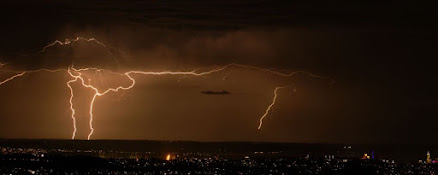
Lightning over the Kitsap Peninsula
Picture courtesy of Adam Sapek

For the 24-h ending at 1 AM this morning (Friday), lightning was widespread over the entire region (each + or - sign is an individual lightning stroke)

During the previous day, eastern Oregon and Washington enjoyed the lightning shows

Wednesday had a strong band crossing northern Idaho and more over southwest Oregon
While Tuesday had lightning filling southwest Washington and western Oregon.


So why has the Northwest enjoyed this flashy period?  

Every Northwest resident instinctually knows the answer: Blame California!
And they would be right.

During the past several days, a low center has been parked along the California coast (see the 500hPa chart--for about 18,000 ft--from Tuesday afternoon).  The winds are also shown, indicating southerly winds over the U.S.  southwest and southeasterly (from the southeast) winds over the Northwest.


This flow is very favorable for instability and thunderstorms over the northwest.

First, easterly flow in the lower atmosphere pushes the cool, marine influence out to sea.  

Cool, dense low-level air near the surface is problematic for thunderstorms, which depends on rapid cooling with height.

Second, the wind circulation swings in moist, warm air aloft over our region.   This is made starkly clear from a moisture-channel satellite picture, which shows the distribution of water vapor over the west on Tuesday afternoon.  You can see the moisture revolving around the low.

 Water vapor is good for thunderstorms, since its condensation into clouds and precipitation releases latent heat.  And such heating helps make the air more buoyant.


The circulation is also pulling warm air in the lower atmosphere into our region, which is also good for thunderstorms (the temperatures and wind at around 10,000 ft for late Tuesday is shown below).

So for a number of reasons, a low along the California coast is favorable for Northwest thunderstorms.

And some of these storms have been quite impressive and beautiful. Below is a visible image around 6 PM Thursday.  Each of the oval cloud structures is the cirrus anvil of thunderstorms.


The radar imagery at this time (below) shows some substantial echoes, indicating heavy precipitation (red and orange are heaviest)


Some good news....expect drying conditions on Saturday as the California low has weakened.
__________________

The Northwest Weather Workshop agenda and information are online.   This meeting, which will take place on May 12-13th in Seattle, is the major weather meeting of the year in the Northwest.   We have a varied and interesting agenda.  The meeting is open to everyone and if you want to attend you must register (on the website).   

We will also have a banquet/talk at Ivar's Salmon House on Friday May, 12.  This is a fun meeting and will be hybrid (in person and on zoom).


Snow in the Mountains and Wet

The rapid transition to cool, wet conditions occurred yesterday, with temperatures in Seattle declining from 80F on Tuesday to 58F in Wednes...