December 05, 2011

Seattle's Math Secret Revealed (Revised)

A few weeks ago I was sworn to secrecy by a Seattle School Board member after he/she revealed a stunning fact:  one of Seattle's middle schools has had an extraordinary, if not meteoric, rise in student math performance.  A middle school with very high levels of underprivileged kids--Mercer Middle School--had student math scores equal to the best in the city.  And he/she had found out why:  without permission from the district, the school's teachers had ditched the district's official curricula (Connected Math), a very poor "discovery" program, for the excellent, and far more traditional Saxon Math series.  That school board member asked me and others to keep quiet about it, because if it got out the District administration (headed by Superintendent Susan Enfield) might well end the experiment.

(For those not familiar with discovery math, it is approach in which "direct instruction" is phased out in favor of having students "discover" math principles on their own.  Lots of talking about the process of discovery, group work is stressed as is calculator usage.  Exercises to encourage competency in basic algorithms are frowned on--they call it "drill and kill.")

Well, today the secret was revealed thanks to a front page Seattle Times article by Brian Rosenthal. As noted by Seattle School Director Kay Smith Blum: "They did it sort of undercover."

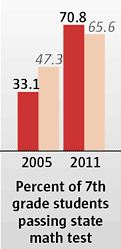
 How good are the results at Mercer?  How many ways can you say spectacular?  To start, here is a graphic from the Seattle Times for the percentage of 7th Grade students passing the state math exam.  In 2005, with the WASL, only 33% of the students passed the exam, compared to 47.3% of the students from the entire district.  Mercer Middle School students were lagging behind.  In 2011 on the state MSP exam, students at Mercer WERE DOING BETTER than the district average. (NOTE:  you can't compare the two years directly--different exams!!, but you can compare differences within the district)
But let me show you some graphics based on this year's State MSP math exam (thanks to Paul Dunham for providing the data). These plots show you the performance of several middle schools, with the schools in order of percentage of students on free and reduced lunch.  The ones on the left are schools with rich demographics and on the right, schools with poorer students. Mercer is the second from the right in all of them. In general you would expect the richer, more privileged students to do better for the obvious reasons.

First lets compare the performance of the various schools for blacks, hispanics, and asians.  Mercer is the best for blacks and hispanics, and a close second for asians.

Or how about low income and limited-English kids in 6th grade?  Mercer is the best!
 Seventh Grade?  Mercer is the best for low income and second best for limited English.
The district has had a huge problem of minority and underprivileged kids doing much worse in math than the rest of the district.  Mercer has essentially solved the problem by going against the district's chosen curriculum.

Here is more proof it is the changed math curriculum that has made the difference.  Take a look at the 8th grade math performance at Mercer compared to other Seattle middle schools:
Mercer's performance has worsened compared to the others.  There is a reason.  According to a teacher from Mercer who left a comment on this blog, Mercer does not use Saxon in the 8th grade..only 6th and 7th, and only for struggling students.  Thus, student performance starts to decline relative to other schools in 8th grade.  This really is unfortunate.  It is like finding someone that is drowning.   You throw them a life preserver and they think they are saved.  Then you take the life preserver away and let them flail in the water again.  Just not right.

This underground experiment is not the only in the city.  Two schools in the city: Schmitz Park and North Beach Elementary (see PS below) have gotten permission for limited periods to use non-discovery, more traditional math books.   The result:  HUGE increases in learning and performance of their students.    For example, Schmitz Park Elementary got permission to try Singapore Math textbooks in 2007 (traditional direct instruction).  Its students’ math scores soared: in 2010 the 5th graders had the third highest passing rate in the state on the state test, even though the school has no gifted magnet program.

In some of my previous blogs, I have also described what has happened in other districts when Discovery Math has been replaced by excellent curricula such as Saxon or Singapore.  Scores have jumped substantially in math.

Now the district administration knows about this.  In fact, Superintendent Susan Enfield was asked by the Seattle Times whether she knew about the phenomenal results at Schmitz Park and North Beach (you can watch it below).  She did and her basic answer was that they have a core (Discovery) curriculum and the district is going to stick to it.  Just amazing.  Stunning results do not matter to her at all.  In fact, Dr. Enfield is a proponent of Discovery math and pushed the Discovering Math high school series when she was curriculum head.

Click to see Enfield Interview by Seattle Times
The bottom line of all thisIt is now absolutely clear from a huge amount of evidence that discovery math programs don't work and that they particularly hurt minorities, the disadvantaged, and those with weaker English skills.  They also hurt the top demographics as well.  Seattle has extraordinarily poor discovery math at all levels (Everyday Math-elementary, Connected Math-middle schools, Discovering Math-high schools). Suburban districts like Shoreline and Bellevue have dropped discovery math after seeing it undermine student performance.  Enfield, is clearly not interested in replacing the current curricula and it is up to parents and the school board to force this issue. (As noted in my earlier blogs, discovery math is like a religion to many in the educational community, particularly schools of education.  The latest fad in a long line of failed fads).  The current curricula are crippling the futures of Seattle's kids.  You would think the district would be designing experiments in many of its schools to see which method of instruction works best and then to move to the superior method... it is not.  Imagine, testing various curricula with classes of similar demographics and learning what works and doesn't.  Use this approach to steadily improve instruction and student performance.   You would think that any rational and concerned district would try such a scientific approach.  Not Seattle Public Schools.

If you are a Seattle parent let school board members know what you think, if you are a business, tell the district administration that policies must change.  Susan Enfield is now only interim and the school board will vote in the next few weeks whether to give her a permanent contract--which would be a disaster for our kids.  It is time for a change from her failed policies (and disasters like the firing a popular Ingraham HS principal), and hopefully with the assistance of two new school board members, the district can finally follow logic and the evidence of student performance, and the not the ideological leanings of several in the school district administration.  Superintendent Enfield is so confident of her position she has told the board that if they dared to open the selection processes to consider others, she would remove herself from consideration.  There is a word for such an attitude, but it doesn't belong in a family oriented blog like this one.

PS:   Here is a comment I received that is so relevant and important, I am posting it here:

I was fortunate to be the principal who brought Saxon Math (after the teachers voted for its use)to Seattle’s North Beach Elementary in 2001. I had used it as a teacher and principal on the Spokane Indian Reservation in the early 1990s and we saw great success with Saxon’s traditional material. The Seattle district staff were stressed by my choice of Saxon because it is used, they declared, primarily with lower performing (high risk) students and North Beach was 80% upper middle class. But the supt at the time stressed site-based decision making, so we took advantage of that policy. Saxon Publishers allowed us to be a pilot site with free materials for K-2 the first year.
The next year, our parents and teachers were so supportive of Saxon’s effects on our students, the PTA raised money to buy materials for grades K-5. Saxon Publishers also gave us some special rates. Within 4 years, these “white” kids with their 66% math passing rate in 2000, had achieved 91% passing (for 4th graders at the time). We had proved that curriculum makes a HUGE difference for every economic group of students.
After I left North Beach in 2004, there were concerted efforts by district staff to get rid of Saxon Math. You see, results for the children are rarely the issue in math curriculum choices by urban districts’ decision makers. It’s about being a “team player” with the adults in charge, who follow a particular ideological path of reform materials for creating equity in classrooms, not excellence in mathematics.
The North Beach math scores have dropped precipitously as some assigned principals have fought the parents’ and teachers’ use of Saxon.
By the way, even if Saxon were for only the lower performing kids, that means it should be used by 50% of the nation’s students and 70% of those in urban districts.


December 03, 2011

The Irony of Wintertime High Pressure

High pressure is good, right?   Sunny skies, light winds, and dry conditions?  A nice break from stormy, wet conditions?  Not necessarily true here over the western lowlands during cool season.  For us, high pressure often brings something I personally dislike more than storms---endless low clouds.  And often air pollution as well.

It is Saturday morning and here is the latest visible satellite picture.  Low clouds over the Willamette Valley and western Washington lowlands.  There are clear skies over the mountains, along much of the coast, and yes over those fortunate folks in Sequim and Victoria.  Some higher clouds are found over eastern Washington from a weak system moving southward out of Canada.


As shown by this morning's surface pressure chart. high pressure dominates our region, with the center of the high pressure offshore.  No storms, no rain, no snow.  The pressure gradients over us are weak and the winds are light.  It appears that we are going to be stuck in this pattern for the next week.   Lucky us.


The problem is that in the Northwest, high pressure around during the winter is a low cloud production machine.  First, with a high over us or nearby the winds are light, since the large pressure changes (gradients) are at the periphery of highs.  Less winds means less turbulent mixing of air in the vertical.  Highs generally bring sinking air in the troposphere and thus lack of middle and higher layer clouds.   Lack of clouds means the earth can effectively radiate infrared radiation to space and thus cool the surface.  The cooling surface cools the very lowest portions of the atmosphere.  Air can cool to saturation and give you fog and low clouds.

Saturday morning in Seattle.  Mt. Rainier is straight ahead.  See it?
And having cool air near the surface and warmer air above leads to an inversion--temperatures increasing with height.  And inversions cause the atmosphere to become very stable, with little mixing in the vertical (think of oil above water).  No mixing means you can't bring the warmer air aloft down to the surface...and one stays cool and murky.  Here are the latest temperatures at Seattle--you can see the inversion from 200 to 500 meters above the surface (immediately above the surface there is an issue of a different temperature sensor)
And did I mention that the very long nights this time of the year gives the surface a lot of time to cool and the weak sun hardly produces enough warming to heat the surface and mix this out?  The same weather pattern in the summer would be no problem...we would have sun after perhaps some morning clouds.

And it gets worse.   Since we have had rain for a while the surface is moist, with lots of water to give to the atmosphere, and with high pressure offshore, moisture streams in at low levels off the ocean.  And once in place fog and low clouds cool at the top (infrared cooling to space) and tend to reinforce themselves.  Diabolical.

Now today and tomorrow, the inversion will be weak and shallow enough for there to be a good chance it will mix out a bit this afternoon and give us some sun. Good time to rake leaves or take a walk.   But as we get into next week, we will probably experience days in which we stay in the murk all day.  The good news is that you can get out of this by going up...head to the mountains or even a high park--such as Cougar Mountain regional park.  Or take a walk up Tiger Mountain (top 2500ft). The worst place to be is the southern Sound lowlands.

Finally, a major issue with such situations is air quality.  Inversions and light winds bring deteriorating conditions and in fact the Puget Sound Clean Air Agency has a burn ban going on right now.   Just to prove to you that air quality is declining, here are some plots from two local reporting stations.  We are now seeing moderate  AQ conditions and it won't be long before we are in unhealthy ones. 


Anyway, it helps to know what is going on and that escape is always possible with a short drive.  It gives one a sense of control.

The Meteorology of the Kenmore Air Crash near Sucia Island

On Thursday around 5:15 PM, a Kenmore Air float plane crashed on the south side of  Sucia Island in the San Juans.   An image from the final...