April 25, 2016

The Most Extreme Warm Day in Seattle History: April 18, 2016

On Monday, Seattle experienced a stunning and unparalleled temperature extreme:

the warmest daily temperature relative to normal conditions ever observed for any date since record keeping began at Seattle-Tacoma Airport (1948).  Any date, any season, any year.

Specifically, temperatures on Monday surged to 89F,when the normal maximum temperature for that date was 58F:  a 31F anomaly (difference from the normal high).    Never had the daily maximum been so far from the average maximum.  Just amazing.

The daily records showed this was the largest maximum temperature anomaly on record, with April 1, 1987 coming in at second place (28F anomaly).   Here are the top ten daily maximum temperature anomalies provided by Mark Stoelinga, a research meteorologist at Vaisalla, Inc.   You will notice the most of the top events are in spring, with April being heavily represented.  Why spring?

Average highs are relatively low in April (mid 50s to lower 60sF) and the sun is getting quite strong (the sun's intensity and duration on April 21st is the same as on August 21st).  May and early June is also a good period for extreme maximum temperatures compared to normal highs for the same reason.

But even in the best season (spring), to get the truly extreme high temperature anomalies, the atmospheric circulation on both the large and local scales must be just right.

So why was Monday so amazingly anomalous?

We started with a strong upper-level high pressure ridge in the idea location:  just inland from the coast. (see upper level (500hPa, roughly 18,000 ft)  map at 5 PM Monday) On the western periphery of the ridge there is southwesterly flow which brought very warm air northward.

The 850 hPa map (around 5000ft) shows the warm air (red/orange colors) and southerly winds along the coast, with higher heights (pressures) to the east, lower to the west.  The temperatures that morning over Seattle were very warm--higher that all days but one for the period January 1 through May 1.  The existence of a very strong El Nino, with above normal water temperatures along the West Coast, contributed to the warmth.


At low levels there was a modest offshore pressure gradient, so that weak easterly flow was pushing the cool, marine influence away from Sea-Tac Airport.  To show this, let's look at the winds and temperatures (red lines) above Sea-Tac Airport that day (below is a time-height cross section, time increasing to the left, time is in UTC).  1821 is 2 PM on Monday, the y axis is pressure (850 is about 5000 ft).  Weak easterly flow dominated at low levels.  If the flow had been westerly, cool air would have moved over Sea-Tac.   Stronger easterly flow over the Cascades would have produced low pressure near the Cascade foothills that would have drawn in marine air near the surface.

To quote Goldilocks:  everything was "just right."

Some folks will suggest tjat this as a good example of the impacts of global warming, but they would be wrong.  Of the 31.5F anomaly that day, perhaps 1-2 F could be traced to human impacts, the rest are the result of natural variability.   Thus, without any human intervention it would still have been a record-breaking extreme day.

But you want to see this visually?   Here is an analysis done by Mark Stoelinga that shows the trend in yearly maximum extreme temperatures anomalies for the spring season (March, April, May)--blue lines.   We will talk about the other temperatures in another blog.  The biggest anomaly was this year (18C or 31F). And you will note that there is a very slow upward trend during the past 70 years:  about 1 C (1.8F).   Some of that trend is from human-increased greenhouse gases, some from urbanization, some from sensor changes, and some from natural variability.  In any case, the upward trend is small and eclipsed by the natural variability, with its jagged ups and downs.
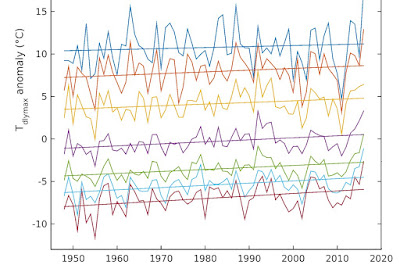


As I noted in my Golden Rule of Climate Extremes:  the greater the climate anomaly, the larger the percentage of that anomaly due to natural variability.


April 23, 2016

TV Meteorologist Jeff Renner Retires from KING TV

One of the most distinguished members of the Northwest meteorological establishment, Jeff Renner, retired from KING TV on Friday, and his on-air presence will be missed.  Those of us in the Puget Sound weather community have come to depend on Jeff as one of our most visible and effective members, and this blog will tell some stories that may not be generally known about Jeff, including his substantial service to the University of Washington and my department.


Jeff came to KING TV as a general reporter in 1977, but became the weather anchor and science lead in 1980.   When St. Helens exploded in May 1980, his in-depth coverage of the event made him well-known throughout the region.   I started at the UW in late 1981 and quickly got to know Jeff at local weather gatherings.  

He was not satisfied being a TV weathercaster, without a weather background.  Jeff was determined to become a real meteorologist and to secure a degree in atmospheric sciences.  And he was willing to take years of math and physics courses that were the first step before entering a degree program, such as the one we offer at the UW.  

I was really impressed.   And during the next few years, he was good to his word.  He fulfilled all the responsibilities of his KING TV job while taking years of technical prerequisites before entering the UW atmospheric sciences program, which he completed successfully.  I enjoyed having Jeff in the senior forecasting class, where he was one the best students.


Jeff developed a reputation as someone who not only had an excellent delivery (and a voice more appropriate for an Olympian god) but a dedication to bring science and education into his message, frequently evincing the knowledge he had gained at the UW as well as an excellent intuition about the weather.   At regional meetings, like the Northwest Weather Conference, you could always be sure Jeff would be in attendance taking notes.

But then a setback occurred in his career.  A new news director at KING decided that a flashy female presence would be beneficial to ratings and Jeff was let go.   Many of us in the weather community protested to KING management (his replacement had no degree in meteorology was making serious technical errors), but it was the unhappiness of the viewers and their demand for Jeff's return that led to his triumphal reinstatement a year later.

During his year off, Jeff applied his formidable communications skills to enter a new sideline:  forensic meteorological consulting.  Many don't know that meteorologists are often hired to do research and testify in court cases, something I have done as well.  There is no better way to find out how weather is influencing people's lives in a serious way.   Jeff rapidly become well known in this endeavor:  he and I have even on the opposite sides for some lawsuits.


Jeff is an uber outdoorsman:   a frequent hiker, sailor, and pilot, among others.  He combined several of these interests with writing to produce a series of popular books on weather for outdoors enthusiasts.


 And he didn't stop there.   Over the years, Jeff created a number of excellent educational 1-hr specials on meteorological topics.

During the last several years, Jeff understood the importance of the developing technology of high-resolution weather prediction and arranged to secure a real-time feed of the UW's super high-resolution WRF output for KING TV , with this information translated into compelling graphical products known as FutureCast (see below).


Finally, Jeff has been a huge friend to the UW. During the years, a number of atmospheric sciences students interested in TV weather have interned at KING 5, gaining invaluable experiment that led to successful careers for several (such as the redoubtable Shannon O'Donnell and MJ McDermott). When the department had special evening lectures for the community, Jeff often was the MC, skillfully guiding the evening, providing wonderful intros for the speakers, and gentling asking for community support at the end.

Jeff retired this week, along with a number of other veterans of KING TV, a sign of downscaling of stations shrinking as TV newscasts become less popular as web access to information gains ascendance.  

But I suspect we have not heard the last from Jeff.  He has never been better as a communicator and his creative abilities are undiminished.   Improving models and internet capabilities do not mean that people don't require an experienced, knowledgeable voice to help them interpret and act upon the huge amount of environmental information that is flooding them.   It is more important than ever and I expect Jeff has some ideas for the future.


The Large Effects of El Nino On Our Current Weather

Our current weather is being profoundly influenced by El Nino.    And that influence is not about to end. Let me demonstrate this to you. Th...