April 02, 2020

It's Bizarre: March was Colder than January In Seattle

Everything seems topsy turvy and unnatural these days, and there is a meteorological oddity that must be added to the list:

March was cold than January in Seattle this year.

I knew March was a cool one, but it was not until Dr. Joseph Zagrodnik, a talented atmospheric scientist working at WSU's AgWeatherNet organization, pointed in out to me, did I realize how unusual the past month had been.

According to Dr. Zagrodnik, the average temp in March at Sea-Tac Airport was 44.8 degrees F compared to 45.1 F in January.

How unusual is this?  Rare, but not unprecedented.  March has been cooler than January 8 times in the 126 years we have temperature records in Seattle, with the last time it occurred in 2006.

To appreciate this oddity visually, the graph below shows the numbers of year the March minus January temperatures fell in various bins.  On average, March is about 5F warmer than January, but in some extreme years March has been as much as 17F warmer.  That would get folks attention. Ten years were close to zero (within .5F of zero) and only a handful (3) were .5 to 1.5F cooler in March.
Another way to appreciate our cool March would be to look at a map of the difference of this year's March temperature from normal  (see below).  Western Washington was much cooler than normal, with some areas 4-5F cooler than typical values.    More normal temperatures east of the Cascade crest.

I know your next question: Why?

A good question. It has to do with an unusual weather pattern that has persisted over the North Pacific during the past month, one that includes a ridge of high pressure offshore with persistent cool, northerly flow over the Northwest. 

The figure below  shows the  height (like pressure) anomalies (difference from normal) around 18,000 ft above the surface (500 h Pa pressure).  Unusually high heights offshore (red) and lower than normal heights (blue/purple).  This is a cold pattern for us, with unusually strong/cold northerly flow over the Northwest coast.
Finally, I wanted to show you an extraordinary picture taken yesterday (Wednesday) around 5:20 PM from the Seattle SpaceNeedle PanoCam.   With cold air aloft and great instability, there was a magnificent line of cumulus clouds along the western slopes of the Cascades.  Just stunning.


April 01, 2020

A Weak Tornado Hits Richland

We have had very unstable air over the Northwest, with lots of convective showers and thunderstorms.  This instability is the result of colder than normal air aloft and a warming surface, producing a large decrease of temperature with height.   Not unlike your cereal pot on the stove top.

One sign of the percolating atmosphere was a tornado that hit the north side of Richland, Washington yesterday (Tuesday) afternoon around 2:45 PM.


This picture was taken by Gabriel Sanchez and was part of a video he made:
https://twitter.com/i/status/1245135193154801665

A satellite image near the time of the tornado shows a line of convection/thunderstorms extending over Richland (see below).  I put a black oval around the tornado location.  You can also see a number of convective storms bubbling up over the western side of the state as well.


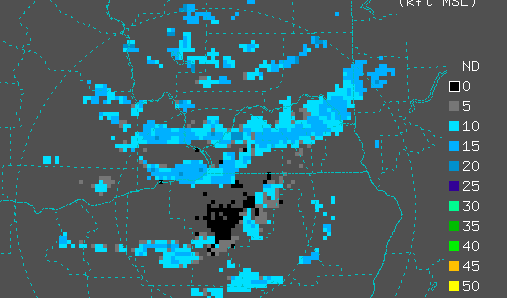
The NWS Pendleton radar imagery at the time of the tornado (2:46 PM) was not exactly impressive, but clearly showed the convective line (I put an oval around the relevant portion-- the image shows reflectivity, a measure of the intensity of the precipitation).  You can see the most intense part (red spot).


The tops of the thunderstorms were wimpy--only around 15, 000 ft. Oklahoma folks would laugh at us!


And the Doppler velocities (below), showing the strength of the flow towards or away from the radar, did not indicate any rotation (which would be shown by contrasting colors signifying a couplet of flow towards and away from the radar).


The UW WWLLN lightning detection network did sense some lightning in portions of the convective line, but to the east of the tornado (picture shows lightning strikes between 2:30 and 3 PM)


This kind of weak tornado, sometimes called a landspout, has a different mechanism from the big supercell tornadoes of the Midwest.

If there is a change of wind speed or direction over distance, that implies some inherent rotation (see schematic).
The updraft from the modest convective cell over Richland can take that rotation and spin it up, not unlike a skater speeds up when he/she stretches upward and pulls in their arms.  Most western WA tornadoes result from a similar mechanism.
At this point, there are no reports of damage or injury from the landspout.


A Very Wet March

This March has been very wet over the western side of Washington State. How wet?  Read on. At Bellingham (through March 29), it has been the...