Whether you are a climate activist, a governmental official, or a citizen hoping to be well-informed on climate issues, getting accurate and reliable climate information is important.
Unfortunately, the Seattle Times continues to provide unfactual information, with screaming headlines and stories that can easily be shown to be incorrect.
This disappointing behavior by Seattle's only newspaper was obvious on Tuesday (see below).
A blaring, big-type headline heralded that "DATA CONFIRMS THAT WARMING IS WORSENING FLOODS, DROUGHT".
And in the subtitle, they double down: "WHAT HAD BEEN AN EXPECTED CONNECTION IS BACKED UP BY A NEW STUDY"

As I will demonstrate below, these claims are unfounded. The study does not confirm anything. And the "expected connection" subheadline is very revealing of the editorial approach of the Seattle Times.
The article
The article, like so many stories in our local newspaper, was a reprint of a Washington Post article (by Kasha Patel): A WARMER WORLD CAUSES EXTREME DROUGHT AND RAIN. INDISPUTABLE NEW RESEARCH PROVES IT.
When a reporter describes research as "indisputable" you know they have little understanding of the scientific process. Science is ALL about disputing and questioning each other's facts and interpretations.

The "indisputable" information in question comes from a single new research paper "Changing intensity of hydroclimate events revealed by Grace and Grace-FO" by Mathew Rodell and Bailing Li of NASA Goddard and published in the journal Nature Water.

This article describes the measurement of the Grace satellites, which can measure the water content of soils from space. Importantly, they only analyzed the period 2002-2021.
Their whole claim of a global warming signal is based on two observations: the last few years had several droughts/heavy rain periods, and the earth has been warming over the past decades.
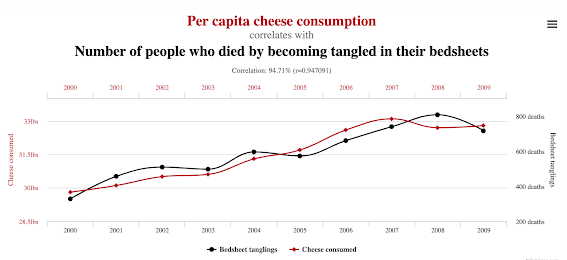
Therefore, global warming/climate change is probably the cause. Correlation proves causation. Poor science logic (see below).
Why these claims are wrong
Let me begin with something that should be obvious: you can't determine a global warming/climate change signal with a 20-year record--it is not long enough.
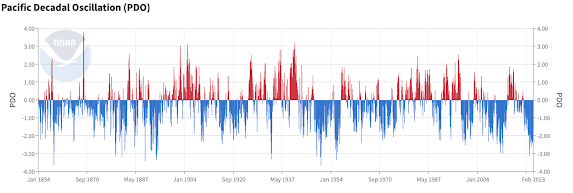
There are many natural sources of climate variability: El Nino/La Nina with a period of 3-7 years, the Pacific Decadal Oscillation with a period of 20-30 years (see below), and others.
So with all these natural sources of variability of precipitation, temperature, and other variables, it is very difficult to pull out a global warming signal over shorter time periods (several decades or less), particularly since the global warming signal is relatively small and slowly growing. Note: it is generally accepted that the Earth has warmed by approximately 1.2°C over the past 150 years.
A closer look at the paper itself reveals several serious additional issues. Let me show you a few.
Below is the key figure of the publication. The extreme hydrological events sensed by satellite are shown by colored dots. The black dashed line shows the monthly "intensity" of the extreme hydrological events, essentially multiplying the number of events by their intensity.
The paper (and the Seattle Times/WA Post article) highlight that the number and intensity of extreme events have risen.
However, the increase in the intensity of extreme hydrological events has been limited to THE LAST THREE YEARS ONLY. That is true for the number of "events" as well.
What was global warming doing during the previous 15 years? On vacation?
In short, there is no longer-term trend in extreme hydrological events that would make you think that global warming/climate change was the cause. Virtually no change from 2002 through 2018.
This is a substantial problem for their hypothesis
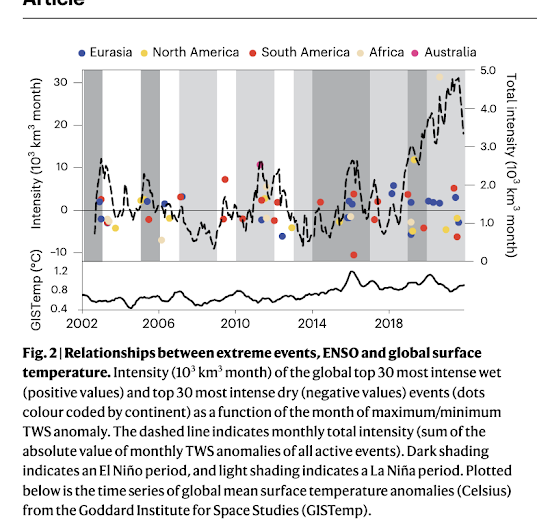
They also plot the change in global mean temperature on the lower panel. You can see a small warming (about 0.2C) over the 20-year period, with 2016 being the warmest year.
The change in extreme hydrological events (abruptly increasing only in the last few years ) is very different from the trend of the global temperature (distributed over the entire period), undermining the authors' claim that global warming might be the cause.
You will note that the warmest year 2016, did not have more extreme events. Furthermore, their plot shows little evidence that the intensity of the extreme events has increased.

Considering the above, does it seem likely that the Washington Post is correct in claiming that the research proves that the forcing of hydrological extremes by global warming is "indisputable"? Of course not.
In fact, the evidence provided in this paper is so thin that a weather researcher (Daniel Swain) is quoted saying:
" I think if this were just coming out of the blue and this is the only evidence we had that hydroclimate extreme was becoming greater in warming climate, it wouldn't be super strong evident unto itself"
Finally, the Seattle Times does not allow comments on stories from outside sources (such as the Washington Post). Obviously, this allows them to publish questionable information without anyone being able to question or comment on it. They do the same thing for their cartoonist, David Horsey, who continuously provides exaggerated and unfounded claims regarding climate.

Newspapers should not be in the advocacy business.
They should be in the business of communicating facts and where there is controversy, both sides of the debate.


